Personalized Medical Care & Dedicated International Patient Concierge

Press Release
My Melasma Looked Darker After Laser Treatment—What Happened 10 Months Later?
Wondering why melasma looked darker after laser treatment? Explore what happened 10 months later, including recovery, pigmentation changes, and treatment insights.
Schedule a Consultation
My Melasma Looked Darker After Laser Treatment—What Happened 10 Months Later?
A patient who underwent full-face UltraPulse Alpha treatment on October 21 last year recently returned to our clinic. She is actually the younger sister of one of my close friends. We have known each other for a long time and share a strong relationship built on trust
Even in a trusting relationship, however, it is completely understandable for a patient to feel worried when the skin appears different from what she expected after treatment.
During the early recovery period, she had one major concern.
“Doctor, I think my melasma looks darker than before.”
After laser treatment, inflammation can temporarily make existing melasma and pigmentation appear more noticeable.
Asian skin, in particular, may be susceptible to post-inflammatory hyperpigmentation, so careful treatment planning and follow-up care are essential.
However, understanding this medically is very different from being the patient who looks in the mirror every day and feels that her melasma has become darker.
“It will improve with time.”
That may sound like a simple explanation from a physician, but for the patient, waiting can require considerable patience and trust.
I did not dismiss her concerns.
I told her that I completely understood why she felt disappointed and anxious, but I also asked her not to judge the final outcome too early.
I said to her:
“I believe the time and patience you have invested will eventually be rewarded with healthier, more beautiful skin.”
Visible improvement at three months
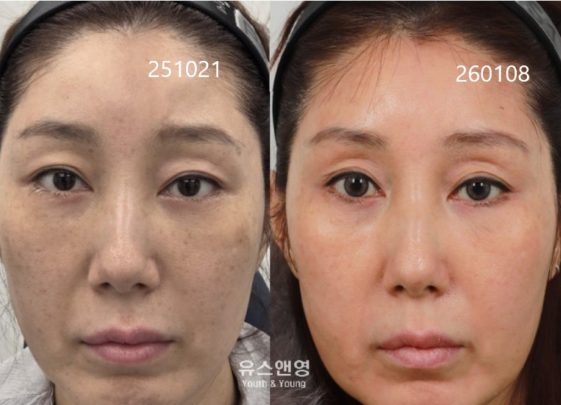
The first set of follow-up photographs was taken approximately three months after her full-face UltraPulse Alpha treatment.
Compared with the pretreatment photographs, her overall complexion appeared clearer and more even.
The widespread areas of pigmentation across the cheeks and around the eyes looked noticeably reduced.
In the frontal view, the uneven and mottled coloration over both cheeks appeared softer, giving the entire face a cleaner and calmer appearance.
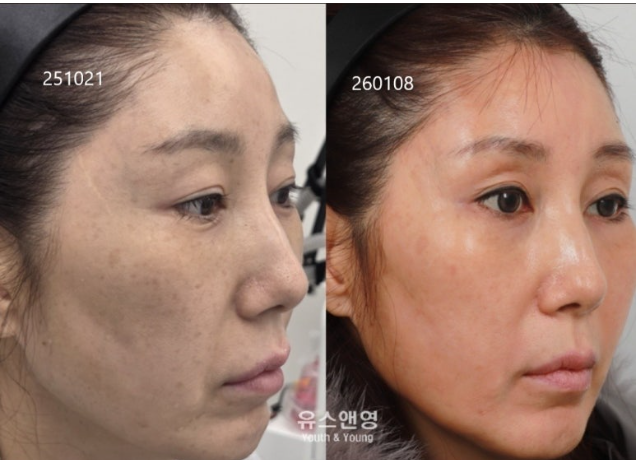
The oblique views showed the changes even more clearly.
Many of the small pigmented spots over the cheekbones and lateral cheeks were less noticeable, while the surface texture appeared smoother and more refined.
The improvement was not simply a matter of brighter-looking skin.
Her previously rough and dull complexion appeared more uniform, and the skin had developed a healthier, more natural glow.
The three-month result was already encouraging.
But the changes following UltraPulse Alpha treatment did not end there.
Ten months later, her skin looked even better
She returned in August, approximately ten months after treatment.
To my surprise and delight, her skin looked even better than it had at the three-month follow-up.
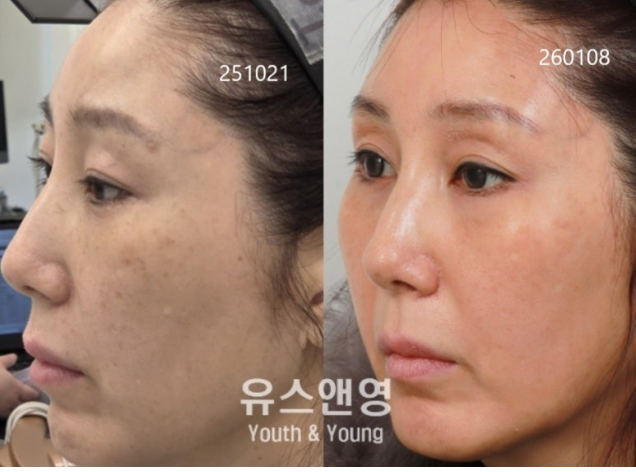
Across the frontal and oblique views, the brown pigmentation that had previously been visible beneath the eyes and over the cheekbones appeared lighter.
The tone of both cheeks also looked more even.
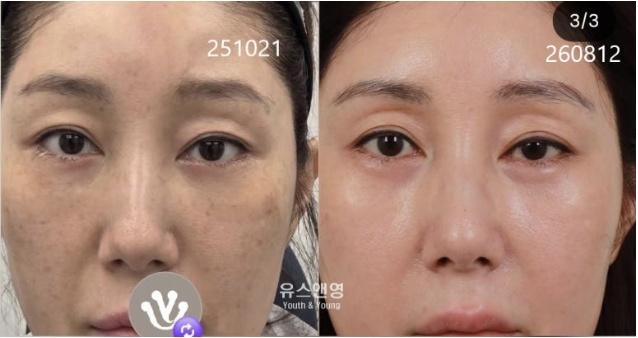
The skin extending from the eye area to the cheeks appeared clearer, while the uneven texture that had previously been noticeable around the nose and central cheeks looked softer.
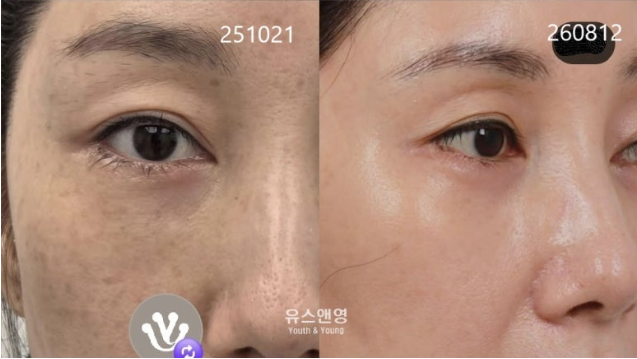
Her skin showed a natural, hydrated luminosity—not simply an oily shine, but the appearance of healthier and more refined skin.
The consistent improvement in pigmentation, tone and texture across several facial angles is meaningful.
This was the same patient who had initially worried that her melasma had become darker.
Because she is the younger sister of a close friend, I also felt a significant sense of responsibility.
The stronger the relationship of trust, the greater my desire to provide a satisfactory result.
When I saw her at the ten-month follow-up, I was genuinely happy for her.
I almost wanted to say,
“Aren’t you glad you waited?”
But the photographs seemed to answer that question for us.
Skin regeneration does not end on the day of treatment
The skin first needs time to settle and recover.
Its texture and firmness may then continue to change gradually as tissue remodeling and new collagen formation progress.
Pigmentation is also influenced by many factors, including the individual condition of the skin, sun exposure, lifestyle and hormonal changes.
For this reason, melasma requires long-term observation and ongoing management.
Melasma should not be described as a condition that can always be permanently removed with a single procedure.
Pigmentation may temporarily appear darker after laser treatment.
Some patients may develop post-inflammatory hyperpigmentation or experience worsening of melasma.
If this occurs, the skin should be medically evaluated rather than assuming that waiting alone will solve every case.
The treatment intensity must be selected according to the patient’s skin characteristics.
Careful sun protection, appropriate post-treatment care and regular monitoring throughout the healing process are equally important.
Wanting to improve even further
When I saw how much her skin had improved after ten months, I naturally wanted to make it even better.
Apparently, she felt the same way.
“Doctor, I would like to do it one more time.”
We then adjusted the treatment plan according to her current skin condition.
The experience gained from the first procedure provides valuable information for planning the second.
It allows us to consider which areas reacted sensitively, when the pigmentation began to stabilize, and how much improvement occurred in tone and texture.
UltraPulse Alpha is not a treatment in which the device automatically creates the result.