Personalized Medical Care & Dedicated International Patient Concierge


Medical Guide
Under-Eye Bags After 40, 50, and 60: Candidacy by Decade
How age changes what causes under-eye bags and which technique fits: fat protrusion in the forties, skin and tendon laxity later, and what that means for you.
Schedule a ConsultationUnder-Eye Bags After 40, 50, and 60: How Age Changes Candidacy and Technique Choice

Medically reviewed by Dr. Joong-Ha Ryu, Director and Medical Advisor, Surgeon, MD, PhD
Patients asking about under eye bags after 50 are usually asking two things at once: is it too late, and is it the same operation younger patients have. The answer to the first is that age is not the criterion. The answer to the second is that it often is not — because what produces the bag changes over the decades, and the technique follows the cause. Youth&Young Clinic Cheongdam decides this by assessing fat protrusion, hollowness and skin condition rather than by date of birth.
What Actually Changes With Age
StatPearls describes aging as affecting every layer of the lower eyelid, with four changes appearing in combination:
- Skin becoming redundant. Called dermatochalasis, it can be aggravated by repeated swelling and inflammation.
- Fat prolapsing forward. Loss of orbital septum integrity lets the fat behind it protrude, with familial tendency and a history of repeated edema and inflammation both playing a part.
- Canthal tendon laxity. The tendons lengthen while the tarsal plate barely does — StatPearls gives the tarsus as normally about 56 mm high and 1 mm thick — which shifts the lid's position against the globe and changes the shape of the palpebral fissure.
- Orbicularis muscle tone changing. This can impair the closure mechanism, and StatPearls notes some patients develop ectropion with frequent tearing, while others develop orbicularis hypertrophy that may lead to entropion.
Alongside those, soft tissue deflates and descends, held back by fixed retaining ligaments, producing the concavity patients typically read as under-eye darkness. StatPearls also lists midface changes — tear trough deformity, midfacial folds and malar festoons — as interacting with the lower lid, and advises examining the midface before lower eyelid surgery for exactly that reason.
The sequence is not identical in every face, which is why the decade headings below are a rough map rather than a schedule.
The Forties: Usually a Fat Problem
In this decade the complaint is most often a discrete bulge that is worse on waking, with skin that still looks reasonably smooth at rest.
That combination is the closest fit for transconjunctival fat repositioning. Youth&Young Clinic Cheongdam describes the technique as especially appropriate when the main concern is fat protrusion and there is little excess skin to remove, with access through the inner surface of the lower eyelid, a CO₂ laser used for access, and the protruding fat moved into the hollow areas below.
What to check even in a straightforward-looking case: whether a groove has already formed below the bulge, because that determines whether there is anywhere for the fat to go.
The Fifties: The Mixed Picture
By this decade more than one change is usually present at once, and the plan becomes a question of proportion.
Skin laxity is the variable that most often redirects the plan. StatPearls describes assessing it with a pinch test performed while the patient looks up and opens the mouth, and describes the pinch technique — marking and excising the redundant skin below the lashes — as the method for moderate to severe lower-lid skin laxity. It also notes that laser skin resurfacing with CO₂ or Erbium YAG can address milder skin laxity, while observing that CO₂ resurfacing suits a limited range of skin types.
Youth&Young Clinic Cheongdam states that a marked skin excess on the lower lid points toward another technique or an added one. Its lower blepharoplasty service covers removing or repositioning fat, removing excess skin, or adjusting eyelid support depending on anatomy, with incisions placed either below the lashes or inside the eyelid.
Hollowing is the other variable that grows in this decade. Where volume loss dominates, the clinic also offers under-eye dermal fat grafting, which uses the patient's own fat to restore volume beneath the eyes — noting that some transferred fat is reabsorbed during healing and that final results take three to six months to assess.
The Sixties and Beyond: Support Becomes Central
Here the question is less often "what should be removed" and more often "will the lid hold its position."
StatPearls describes measuring lid laxity directly: a lid that needs a blink before it reseats after being drawn off the globe, or that can be distracted beyond 5 mm, is reported as lax. It also describes checking the canthal relationship, with the lateral canthus normally about 2 mm above the medial canthus, and notes that a deep-set eye tends to see the lower lid move upward with age, producing a small horizontal fissure, while a prominent eye is more prone to downward migration of the lateral canthus and a rounder appearance with possible scleral show.
Where laxity is present, StatPearls describes lateral canthopexy or canthoplasty as the techniques used to address it during lower eyelid surgery, with medial canthoplasty for medial tendon laxity. Youth&Young Clinic Cheongdam's lower blepharoplasty description likewise includes adjusting eyelid support as one of the things surgery may involve.
Skipping this assessment is how a lid that was already struggling ends up retracted. It is also why the clinic lists eyelid laxity among the findings that call for further assessment before its under-eye procedure.
Age Is Not the Gate — Health Is
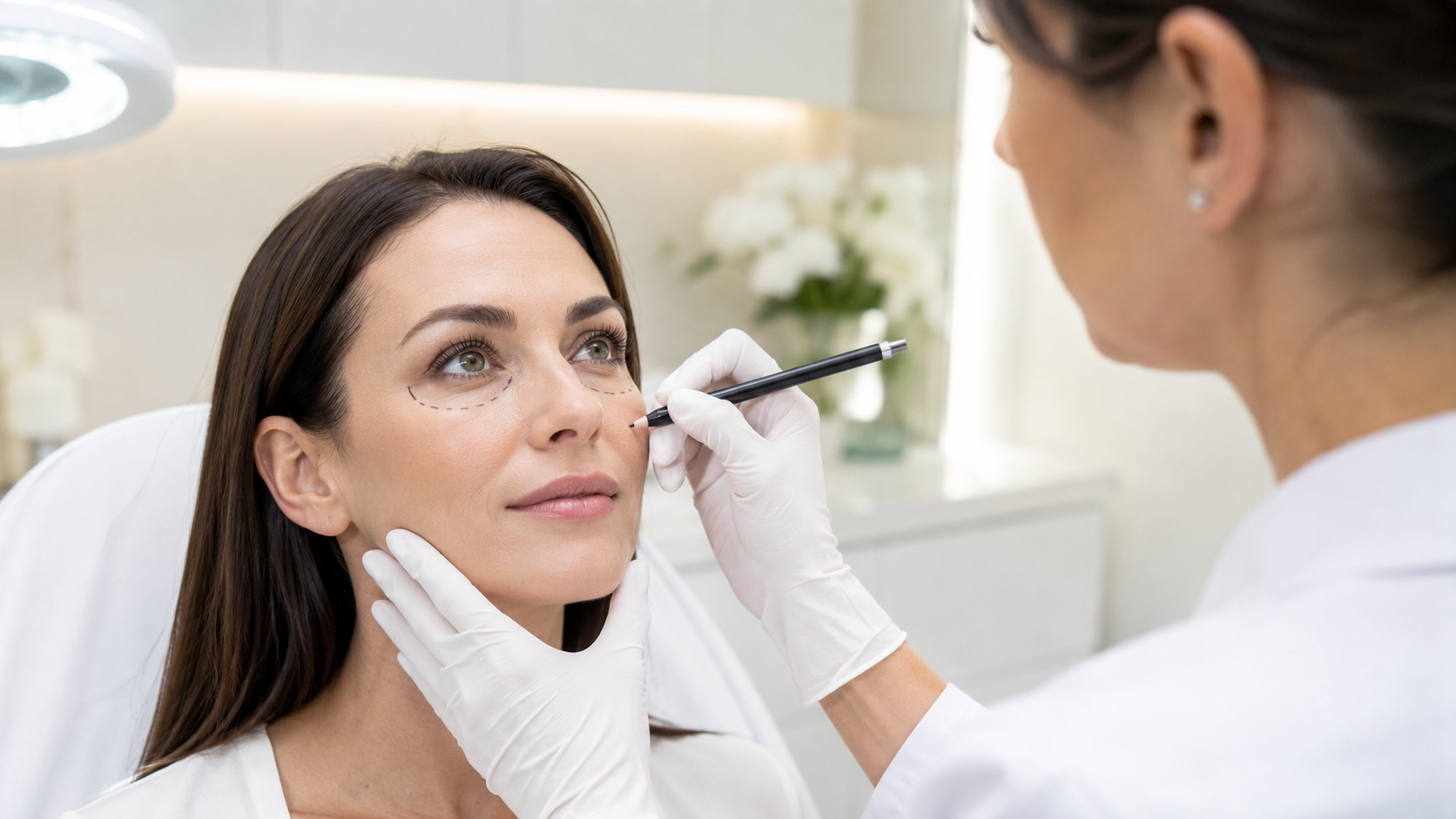
Four things appear on the American Society of Plastic Surgeons' description of who makes a good eyelid-surgery candidate: general health that does not compromise healing, not smoking, goals that are realistic and an outlook to match, and eyes free of serious disease. Age is not one of them.
What does become more common with age is the set of findings that change planning:
- Medications affecting bleeding. StatPearls describes documenting and optimizing bleeding tendency before surgery where possible, specifically to reduce the risk of retrobulbar hemorrhage and subsequent blindness, with nonsteroidal anti-inflammatory drugs typically stopped two weeks before and warfarin held until prothrombin time normalizes.
- Blood pressure. StatPearls notes hypertensive patients should be well controlled for at least two weeks before surgery.
- Continuous positive airway pressure use, which StatPearls flags as predisposing to postoperative malar edema.
- Dry eye, already more prevalent, and worsened temporarily by surgery that impairs closure and blinking.
- Thyroid disease, which Youth&Young Clinic Cheongdam lists among the conditions to disclose for eyelid surgery alongside glaucoma, diabetes, cardiovascular conditions and relevant medications.
The clinic is explicit that prescribed medication must not be stopped without medical approval. The disclosure is the patient's job; the adjustment is the prescriber's.
Anesthesia Planning Changes With Age Too
For Encore the clinic specifies local anesthesia. Where sedation or general anesthesia enters the plan, age becomes more relevant.
MedlinePlus notes that temporary confusion after anesthesia can last several days in some people over the age of 60, and lists arrhythmia, breathing problems and allergic reaction among the risks of general anesthesia in particular. Youth&Young Clinic Cheongdam notes that patients with extensive comorbidities may not be suitable for general anesthesia and that stable systemic health or well-managed chronic conditions make for a more straightforward anesthesia plan.
The clinic's team includes Dr. Young-yeon Hwang, a board-certified specialist in anesthesiology and pain medicine, with the clinic since 2018, and a resident anesthesiologist is present at surgery. For an older patient weighing a procedure abroad, who is handling anesthesia is a fair question to ask directly.
Expectations by Decade
One thing does not change: the clinic's statement that its under-eye procedure may not resolve dark circles caused by pigmentation, thin skin, or visible blood vessels. If anything, thin skin becomes a larger contributor over time, since StatPearls records lower eyelid skin as under 1 mm thick with no subcutaneous fat layer.
Youth&Young Clinic Cheongdam also notes, for lower blepharoplasty, that results can be long-lasting but that natural aging and changes in skin and facial tissues continue, and that individual outcomes and longevity vary. A sixty-year-old and a forty-year-old should both expect a change rather than a reset — and should both expect the face to keep changing afterward.
Patients can review the clinic's treatment photographs to calibrate what a settled result looks like, and raise decade-specific questions through its English-language enquiry form before booking travel.
The Bottom Line
- Age is not the criterion. The criteria are what the fat, skin, lid support and midface are doing, and those are measured.
- In the forties the complaint is most often isolated fat protrusion — the closest fit for transconjunctival repositioning.
- In the fifties skin laxity and hollowing usually join the picture, and marked skin excess points to another technique or an added one.
- From the sixties, lid support moves to the center of the plan, assessed with the snap-back and distraction measures before anything is decided.
- Health findings that grow more common with age — anticoagulation, hypertension, dry eye, thyroid disease — change planning rather than eligibility, and all of them belong in the consultation.
Frequently Asked Questions

Am I too old for under-eye surgery?
Age is not among the criteria. The American Society of Plastic Surgeons frames suitability around healing capacity, smoking, expectations and eye health instead. What shifts across the decades is the mix of findings a surgeon is working with, not whether you qualify.
Why would a younger patient and an older patient get different operations?
Because the cause of the bag differs. Isolated fat protrusion suits an approach through the inner surface of the lid; marked skin excess cannot be addressed that way at all, and lid laxity may require support to be adjusted as part of the plan.
Is skin laxity always a reason for a different technique?
Not always — the question is severity. StatPearls describes a pinch test with the patient looking up and the mouth open to judge it, with the pinch technique used for moderate to severe laxity and laser resurfacing considered for milder cases. Youth&Young Clinic Cheongdam frames marked excess as pointing to another or an added technique.
My lower lid seems to sit lower than it used to. Does that matter?
It does, and it should be measured rather than described. StatPearls documents lid position in millimeters relative to the inferior corneal limbus and notes that prominent eyes are more prone to downward migration of the lateral canthus. That finding influences whether lid support is addressed.
Does being on blood thinners rule me out?
No, but it is a planning item with a serious rationale. StatPearls describes optimizing bleeding tendency before surgery to reduce the risk of retrobulbar hemorrhage and the vision loss that can follow. Any change to prescribed medication is the prescribing clinician's decision, not the patient's and not the surgeon's alone.
Will results last as long if I have surgery later?
Youth&Young Clinic Cheongdam notes that results can be long-lasting but that natural aging and tissue changes continue, with individual outcomes and longevity varying. Nothing about that statement changes by decade.
Should an older patient worry more about anesthesia?
The Encore procedure is specified as local anesthesia, which MedlinePlus describes as numbing a small area with the patient awake. Where sedation or general anesthesia is planned, MedlinePlus notes temporary confusion can last several days in some people over 60 — which is a reason for an anesthesia consultation, and the clinic has a specialist for it.
This article is for general informational purposes and does not constitute individualized medical advice. Surgical candidacy, technique, and expected outcomes can only be determined through a consultation with a qualified physician. It is not a self-diagnosis tool.
More Articles
Continue reading our clinical guides.

Under-Eye Bags After 40, 50, and 60: Candidacy by Decade
How age changes what causes under-eye bags and which technique fits: fat protrusion in the forties, skin and tendon laxity later, and what that means for you.
Learn More

Encore Under-Eye Fat Repositioning: A Patient Guide
What Encore under-eye fat repositioning is, how the transconjunctival laser approach works, who it suits, and what recovery looks like week by week.
Learn More

Dissolvable Stitches After Under-Eye Surgery and Flying Home
Encore under-eye fat repositioning uses absorbable sutures, so no stitch-removal visit is scheduled. What that changes about trip length and the flight home.
Learn More