Personalized Medical Care & Dedicated International Patient Concierge


Eyelid & Under-Eye Surgery · Consultation Required
Lower Blepharoplasty
Lower blepharoplasty is a surgical procedure that addresses under-eye bags, excess lower-eyelid skin, and certain eyelid contour concerns.
Schedule a ConsultationLower Blepharoplasty in Seoul

Medically reviewed by Dr. Joong-Ha Ryu, MD, PhD.
Youth&Young Clinic Cheongdam, Gangnam-gu, Seoul
Lower blepharoplasty Korea searches almost always start with the same complaint: bags under the eyes that make a rested face look tired. Lower eyelid surgery in Seoul addresses that, along with excess lower-eyelid skin and certain contour concerns, by removing or repositioning fat, taking away excess skin, or adjusting the lid's own support. At Youth&Young Clinic Cheongdam this eye bag removal surgery is one of several operations under Eyelid & Under-Eye Surgery.
What Is Lower Blepharoplasty?
Lower blepharoplasty is a surgical procedure that addresses under-eye bags, excess lower-eyelid skin, and certain eyelid contour concerns.
What is actually done varies with anatomy: fat may be removed, fat may be moved to a different position, skin may be excised, or the support of the eyelid may be tightened.
The incision sits either just below the lash line or on the inner surface of the lid, and the choice follows the plan rather than the other way round.
The operation commonly takes approximately one to two hours, depending on complexity and on what is planned.
It is often performed as day surgery, with preoperative assessment and postoperative follow-up both required.
Suture removal may be needed, depending on which closure technique is used.
One thing the procedure cannot be asked to do is settle every under-eye complaint at once. It may reduce puffiness and excess skin and improve the contour, and the degree of improvement depends on your anatomy, skin quality, healing and the technique chosen. Complete removal of dark circles, of fine lines, or of all under-eye hollowing is not something it can guarantee.
Who Performs Lower Blepharoplasty at Youth&Young Clinic Cheongdam
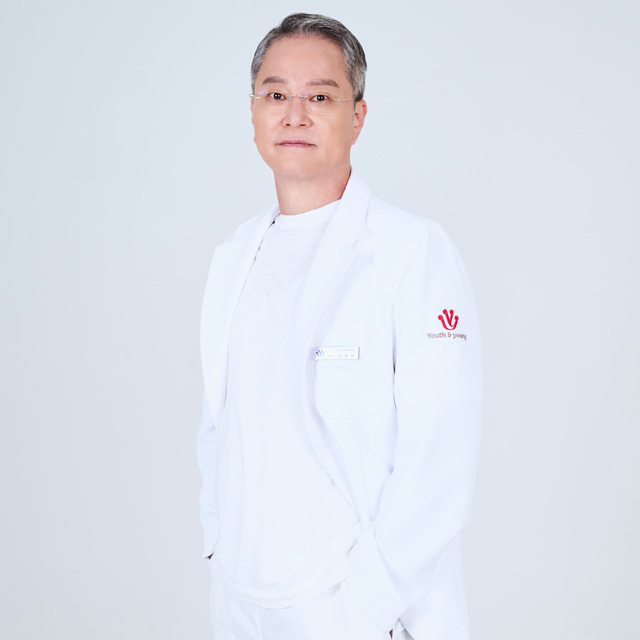
Dr. Joong-Ha Ryu, MD, PhD
Plastic Surgeon
This operation is handled by Dr. Joong-Ha Ryu, who leads it.
Dr. Ryu is the clinic’s Director and Medical Advisor and holds MD and PhD degrees. More than thirty years of his clinical practice has been spent on the lower eyelid specifically — laser-assisted lower-eyelid fat repositioning through the transconjunctival route is his named subspecialty — which is the half of lower blepharoplasty concerned with what to do about the fat. He has also worked in CO₂ laser resurfacing and laser deep dermabrasion across the same period, relevant here because surface texture and lid contour are frequently confused by patients and need to be separated during assessment.
This page does not claim one doctor performs every session.
Lower Blepharoplasty Options / Types Available
The Foundation describes two incision routes into the lower lid, and they are not interchangeable.
Route | Where the incision goes | What it suits |
|---|---|---|
Below the lash line | An external incision just under the lashes | Plans that involve removing excess skin as well as managing fat, since skin can be addressed directly |
Inside the eyelid | The inner surface of the lower lid, leaving the skin unbroken | Plans focused on the fat compartments where there is little skin to remove |
National health guidance records both routes for lower-lid surgery and notes that fat is repositioned or removed through them (NHS). The surgeon's choice between them follows the examination. If a clinic names the route before examining you, that is the wrong order.
Who Is a Good Candidate for Lower Blepharoplasty?
Adults with persistent under-eye bags, excess lower-eyelid skin, or lower-eyelid contour concerns suited to surgery.
People in appropriate general health who hold realistic expectations about what will change.
People whose anatomy and eye health have been assessed by a qualified surgeon, since suitability cannot be determined from appearance alone.
Further assessment, postponement or a different answer may apply to:
Anyone with an uncontrolled medical condition.
People with significant dry-eye symptoms.
People with prominent eyes, where lid position after surgery needs particular thought.
People with bleeding disorders or other eye-health concerns.
Surgery may need to be put off until the relevant issue has been evaluated or managed. That is a delay, not a refusal, and a surgeon who imposes one is doing the job.
What to Expect: Procedure, Recovery, and Results Timeline
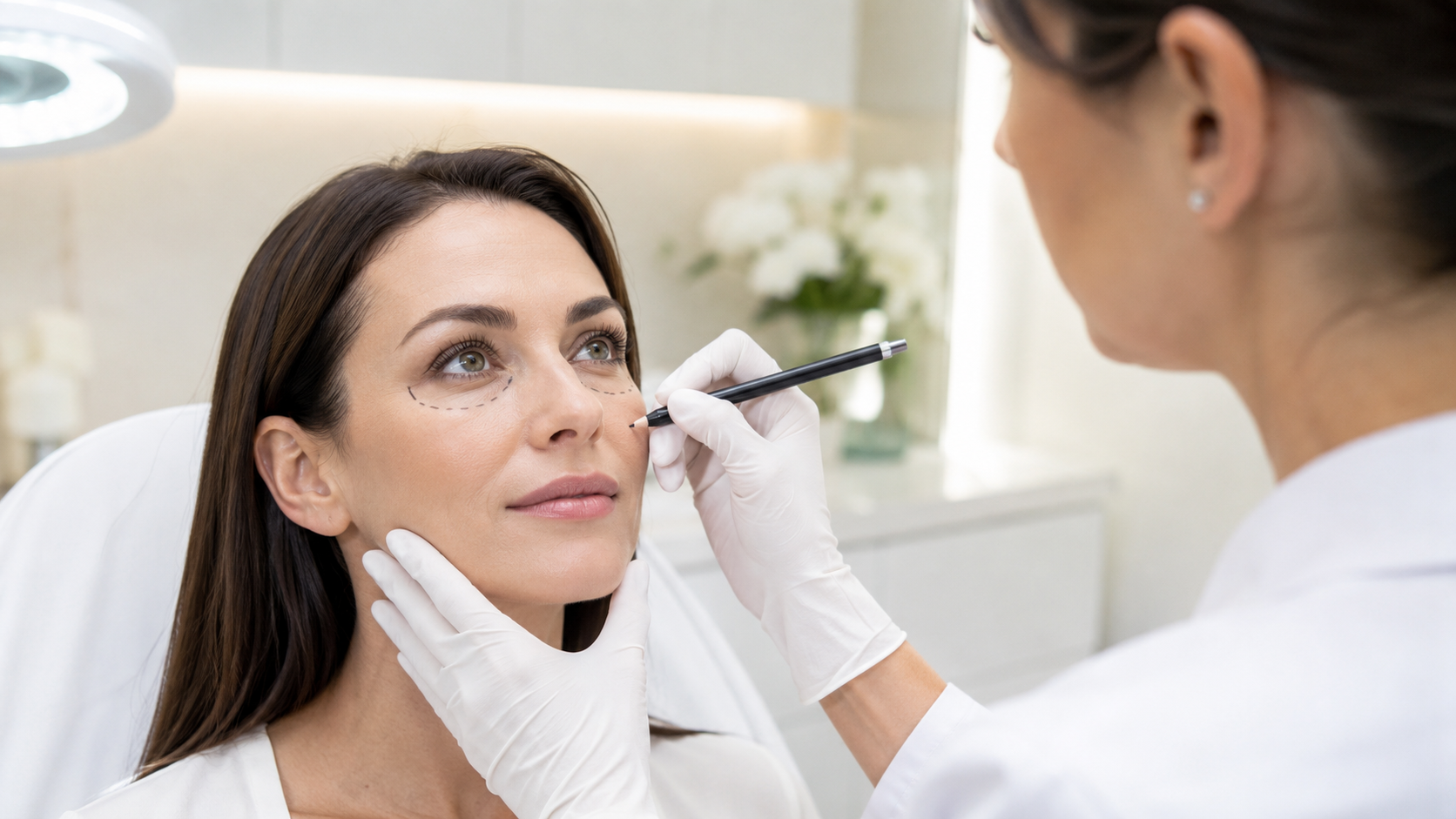
The consultation covers your concerns, your medical and surgical history, your current medications, any eye symptoms and your goals. The examination looks at the lower eyelids themselves: skin laxity, how prominent the fat is, where the lid sits, and the eye-health factors that bear on all of it. A surgical approach is recommended only after that.
Preparation starts with a full disclosure of medications, supplements, allergies, medical conditions, prior eye procedures and dry-eye symptoms. Instructions about fasting, smoking and medication changes are individual to you. Prescribed blood thinners and other medicines are never stopped without guidance from the clinician who prescribed them. If sedation or general anesthesia is used, arrange transport home before the day.
The anesthesia plan belongs to the treating team. Lower blepharoplasty may be performed under local anesthesia, with sedation, or under general anesthesia, depending on the surgical plan and on what the patient needs. That work falls under Anesthesiology & Pain Medicine at the clinic. The in-house specialist in that field is Dr. Young-yeon Hwang, whose focus includes surgical anesthesia, intraoperative monitoring and pain management before and after an operation. Pain during the operation is minimized by the anesthetic; mild discomfort, tenderness, swelling and bruising afterwards are ordinary.
Stage | What typically happens |
|---|---|
In the operating room | The planned incisions are marked, anesthesia is given, the incision is made below the lashes or inside the lid, excess skin or fat is removed or fat is repositioned, and the incisions are closed |
First days | Swelling, bruising, tenderness, dryness or watering |
Approximately 1–2 weeks | Swelling and bruising commonly improve, though some symptoms last longer |
Weeks to months | The appearance keeps settling; final healing outlasts the initial recovery period |
Aftercare means wound care as instructed, any prescribed eye drops or ointments, cold compresses, sleeping with the head raised and keeping your follow-up appointments. Do not rub the eyes. Exercise, contact lenses and other activities resume when you are told they may, not when they feel possible. The healing area is kept out of the sun.
Early changes show as the swelling goes down, but the appearance continues to settle over the following weeks and months, and complete healing with a final result may take several months. Results can be long-lasting. They are not permanent in the sense people sometimes mean: natural aging continues, and the skin and facial tissues keep changing around whatever the surgery achieved.
How long to stay in Korea is deliberately not given here as a single number. The stay depends on healing, on how many follow-up appointments you need, and on the surgeon's assessment — confirm the recommended duration before you book travel. Many patients plan to fly home about seven to ten days after lower blepharoplasty, with the actual timing depending on healing, travel distance and what the surgeon says. Allow margin: bruising and redness can take several weeks to fade, and the flight from Seoul to the United States is a long one.
Combining Lower Blepharoplasty with Other Treatments
Upper-lid surgery is sometimes performed in the same operation, where the assessment supports treating both lids rather than one.
Facelift Surgery is among the procedures that may be combined with it, when the concern extends beyond the eye region.
Selected resurfacing treatments under Laser Dermatology may be considered alongside it, where surface texture is part of the complaint.
Suitability, the added risks, and the extra recovery each combination brings must be assessed individually. Combining two operations is not simply the sum of two recoveries, and the surgeon should say what the combined downtime looks like before you agree to it.
Safety, Precision, and Clinic Standards
Potential side effects include swelling, bruising, discomfort, dryness, irritation, tearing, and temporary blurred vision. Possible complications include infection, bleeding, asymmetry, scarring, difficulty closing the eyes, lower-eyelid retraction or outward turning, and the need for revision surgery. Serious vision complications are rare but possible.
Within that list, one item deserves its own paragraph. Outward turning of the lower lid — ectropion — is specific to this operation in a way the other risks are not, because the lower lid's position depends on tissue that the surgery works directly on. The same complication appears on national guidance for eyelid surgery, which also lists occasional blurred or double vision, asymmetry, noticeable scarring and altered sensation, and rarely injury to the eye muscles, bleeding into the eye socket or visual impairment. Asking the surgeon how lid support is being preserved in your particular plan is a reasonable and specific question.
The clinic holds Korean business registration number 720-46-00344. It is a Registered Medical Institution for Attracting Foreign Patients under the Ministry of Health and Welfare, in compliance with the Medical Overseas Expansion and Foreign Patients Attraction Act. That is a registration for treating international patients; it is not a facility accreditation.
What the equipment answer should sound like
The Foundation's account of what this operation requires is unglamorous and correct: appropriate surgical instruments, sterile operating facilities, and monitoring matched to the anesthesia plan. There is no device to be impressed by here. The monitoring clause is the part worth hearing about, because it is the one that scales with the anesthesia chosen, and a clinic should be able to describe who monitors you and with what if sedation or general anesthesia is on the plan.
The consultation, before you decide
Put three questions to the surgeon before you consent — what the operation involves, what will be used during it, and what its failure modes are — and refuse to be hurried into answering on the day. A cooling-off period after the consultation is the described norm, not a concession (NHS). Americans consulting the clinic raise a consistent set of items alongside that: what the surgeon's procedure-specific experience is, what the anesthesia arrangements are, whether the written estimate is complete, whether before-and-after cases are shown without guaranteed-outcome claims, how photographs and personal data are stored, and what the clinic does when an adverse event occurs.
Two of those are easy to skip and expensive to skip. The first is consent explained in English in enough detail that you could repeat the risk list back. The second is the photography question, settled before the first set is taken rather than after.
Follow-up once you have flown
A clinic on another continent cannot be assumed to supply the aftercare you would get at home, or to supply it at the level you would expect, and no clinician where you live is obliged to pick the case up. Decide in advance who deals with a complication, where the checks take place, and who is paying for them (NHS).
What Youth&Young Clinic Cheongdam states it provides is aftercare instructions in English, clear expectations about downtime, guidance on when travel and sun exposure are appropriate, potential remote follow-up after you return home, and a defined route for international patients who need advice once they have left Korea. Ask what that route is in practice — who answers, in what language, how quickly — and keep the written procedure details and medication list with you, because a clinician in the United States will need them before they can help.
The Bottom Line
Lower blepharoplasty treats under-eye bags, excess lower-eyelid skin and contour concerns by removing or repositioning fat, excising skin, or adjusting eyelid support.
The incision runs either just under the lashes or inside the lid, chosen after examination rather than before it.
It commonly takes one to two hours and is often done as day surgery, with follow-up and possible suture removal.
Swelling and bruising commonly improve over about one to two weeks; final healing takes months, and natural aging continues afterwards.
Lower-eyelid retraction or outward turning is the complication most specific to this operation and is worth discussing by name.
Frequently Asked Questions
Where exactly will the cut be? Either just below your lash line or on the inner surface of the lower lid. The surgeon decides after examining your skin, your fat prominence and your lid position, because the two routes suit different plans. A clinic that commits to one before the examination has skipped a step.
Will this fix my dark circles? Not reliably, and no honest surgeon will promise it. The operation can reduce puffiness and improve the lower-lid contour, which changes the shadow the contour throws. Darkness coming from pigmentation or from fine lines is a different problem with different treatments.
What anesthesia will I have? It depends on the surgical plan and on your medical needs; local anesthesia, sedation, and general anesthesia are all possible and the treating team decides. Temporary discomfort, tightness, swelling and bruising may follow regardless of which is used.
How soon can I fly back to the United States? Many patients aim for about seven to ten days after surgery. Your own date depends on how you are healing, how far you are flying and whether your surgeon agrees you are ready, so treat it as a plan to confirm rather than a booking to make in advance.
When do I look presentable again? Most of the visible swelling and bruising settles over roughly one to two weeks, though some of it persists longer and bruises can take several weeks to fade completely. Make-up, sun exposure and contact lenses all resume on the surgeon's schedule rather than yours.
Are the results permanent? They can be long-lasting, but aging does not stop. Skin and facial tissues continue to change, and individual outcomes and longevity vary. The right expectation is a durable improvement, not a fixed state.
Could I need a second operation? Revision surgery is on the list of possible outcomes, together with asymmetry and scarring. Ask at the consultation how revisions are handled and what they would involve, because that conversation is much harder to start from another continent.
Something looks wrong and I am already home — what now? Contact the clinic through its contact page, by phone on +82-2-545-9393, or by email at info@youthandyoungcheongdam.com. If you have a sudden change in vision, severe eye pain or swelling that is worsening quickly, seek urgent care where you are first and notify the clinic afterwards.
Book a Consultation at Youth&Young Clinic Cheongdam
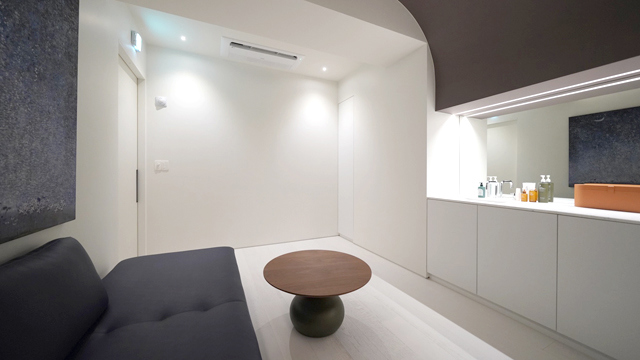
A useful lower blepharoplasty consultation produces a specific plan — which route into the lid, whether fat is being removed or moved, whether skin is coming out, and what the recovery and follow-up schedule looks like against your travel dates. Consultations are available in English, and an initial assessment from photographs can be arranged before you commit to a trip. Book through the clinic contact page, or call +82-2-545-9393. The clinic is at 2F, 49 Dosan-daero 55-gil, Gangnam-gu, Seoul 06014, Republic of Korea, and is open Monday, Tuesday, Thursday and Friday from 10:00 to 19:00 KST, and Saturday from 10:00 to 15:00 KST, excluding the second and fourth Saturdays of each month.
Disclaimer
This page is for general informational purposes and does not constitute individualized medical advice. Candidacy, technique, and expected outcomes can only be determined through a consultation with a qualified physician.
Sources & Further Reading
Other Services
Explore additional treatments offered by our specialists.

Sub-Brow Lift
A sub-brow lift is a surgical procedure that removes selected excess skin, and sometimes a limited amount of underlying tissue, from the upper eyelid through an incision just below the eyebrow.
Learn More

Stem Cell Skin Treatment
Stem cell skin treatment is a broad term used for aesthetic procedures marketed to improve skin quality, texture, hydration, or visible signs of aging using cell-based materials or products described as stem-cell-derived.
Learn More

Stellate Ganglion Block
Stellate ganglion block is an injection-based procedure that delivers local anesthetic near the stellate ganglion, a group of sympathetic nerves located in the lower neck, temporarily interrupting certain sympathetic nerve signals.
Learn More